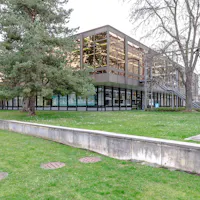

In the late 1960s, when the rusty red-brown-colored staff restaurant was inaugurated in the heart of Klybeck, at the intersection of Mauerstrasse and Klybeckstrasse, Swiss television was also present to capture this moment.
In stark contrast to today, where much consideration is given to the individual wishes of guests and the culinary experience is tailored to suit personal dietary preferences – be it vegan, vegetarian, lactose-free, gluten-free or something else – the focus at that time was on automation, as thousands of associates had to be fed in a very short time.
Swiss television reported on the opening as follows: “State-of-the-art facilities allow almost 4000 lunches to be served thanks to extensive automation. The hungry guests of the Klybeck restaurant, who eat in seven overlapping shifts, are delivered around 2400 meals every hour. A ready-to-eat meal every second and a half.”
It is hard to ascertain whether this rather factory-like approach was conducive to innovation and creativity. In fact, Ursula Sallmann recalled that in 1963, when it was still common for employees to go home for lunch, her husband came up with the basic molecular structure for Voltaren at the table and scribbled the formula on a napkin – a shining example of how big ideas are born.
Nevertheless, the food can’t have tasted all that bad, as innovation has continued to thrive in Klybeck. Today, associates still eat here every day, although the congestion at rush hour is not quite as bad as it was 50 years ago. The number of associates at Klybeck has decreased significantly and, as a result, the once-boisterous restaurant has become rather quiet.
This, however, also offers an opportunity to actually enjoy the elegance of the spacious dining room, which is said to be so large that when you take a seat at one end of the restaurant, the curvature of the earth comes into view on the opposite side.
It is an exaggeration, of course. But the building, constructed from 1965 to 1967 by the leading architects of the time, Suter + Suter, who also planned many other buildings in Klybeck and whose design was modeled on the work of Mies van der Rohe, is a small architectural masterpiece for which the name staff restaurant or canteen does not quite fit.
It is much more apt that in 1970, when Ciba and Geigy merged, the Ciba general meeting was held in the restaurant’s dining area, where two large murals by Hans Erni still hang today, giving the room a solemn – if not almost sacred – aura.
It is therefore easy to imagine that one day trendsetting artists, designers and architects will take up residence in this building, which has been included in the inventory of buildings worthy of preservation and is referred to simply as K-610 in the local industrial jargon. In the marketing language of the start-up world, the building could well be called an art or architecture canteen. We shall see.

You may also be interested in the following:


Thanks for reading Live.Magazine
Stay connected by subscribing to our newsletter
SubscribeBy submitting your email, you consent to Novartis AG collecting and processing your email data for Novartis internal use, in accordance with our privacy policy, and by protected technical means.