When Joerg Reinhardt returned to Novartis in 2013 after a three-year stint as CEO of Bayer Healthcare to chair the Novartis Board of Directors, the company was a heavyweight global life sciences concern that had businesses in diverse healthcare arenas, ranging from vaccines, animal health, and generics to eye care. The conglomerate was not only challenging to lead, but it faced many internal and external barriers, from siloed work cultures and ponderous bureaucratic processes to internal fights over resources. Soon after his appointment, Reinhardt revised the company’s strategy and embarked on driving science-based innovation focused on fast-growing healthcare markets. Over the next 12 years, Novartis radically transformed its structure. It shed its non-core businesses, overhauled its manufacturing park, sharpened its research and development activities, and expanded into new technologies by setting up gene therapy, radioligand and RNA operations. Revenues, net profit, and dividend payouts and its share price grew. Besides attention to the company’s operational transformation, another key strategic line was to work towards a cultural shift to overcome operational silos, reduce rigid hierarchical structures and accelerate internal and external collaboration – all with a view to speeding up the level of innovation needed in today’s highly competitive market. At the same time, Reinhardt also aimed at reshaping the company’s relationship with society. During his long career at Novartis and predecessor company Sandoz, which he joined in 1982, he experienced firsthand how the company was often at odds with the public and repeatedly became the center of massive media criticism. To mend these ties, Novartis worked towards paving the way for more intense exchanges between the company and its diverse shareholders and stakeholder groups. And it was willing to go down untested routes when it came to increasing the touchpoints with society, as Novartis was often perceived in Switzerland as aloof and arrogant. A major step in this direction was the opening of the Campus, often described by locals as a forbidden city, and the creation of the Pavillon, which would allow the public to learn more about the pharmaceutical industry and engage in open debates with the company on important subjects such as data privacy, drug prices and patient involvement in clinical trials.
Joerg Reinhardt talks to one of the architects during the construction period.
When Novartis opened the Pavillon, Reinhardt described the move as a social experiment and an expression of the company’s continual cultural journey towards more openness, which was also a reflection of the changing socio-economic fabric. “Companies – especially in complex industries such as ours – need also to better explain what they are doing. We live in times of increased transparency and heightened public awareness and should therefore welcome interest in our industry and intensify dialogue with the public,” Reinhardt said. This dialogue should not only happen via digital channels, but in places that allow for “sensible and serious discussions. Against this background, it is increasingly important to create spaces in which differing views can be exchanged in a calm and rational manner and in a welcoming and warm atmosphere,” Reinhardt added. This was the idea behind the Pavillon.
The bookshop in the Pavillon offers a large variety of science related books.
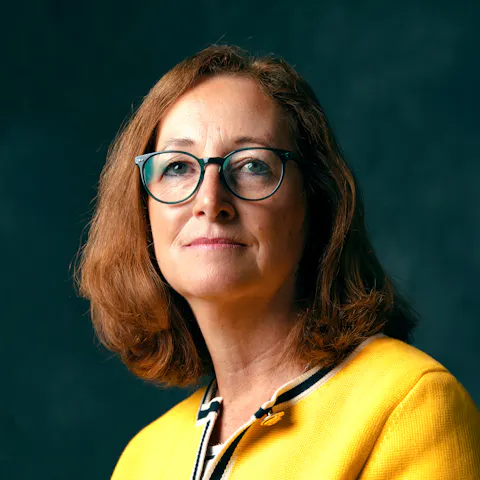
Dr. Reinhardt, has the Novartis Pavillon experiment been successful? From the outset of the Pavillon project, we aimed at creating a space that would give us an opportunity to engage with the public, explain the complexities of our industry and invite them to debate open questions around healthcare and medical innovation. We certainly believed this would kindle some interest. But in all honesty, we never thought that so many people would visit the Pavillon in the first two years of its existence. We hit a nerve, as more than 200,000 people have visited the Pavillon so far. In that sense, the experiment has been successful. What stands out most for you? Of course, the Pavillon is an intrinsically attractive structure that stands out for its circular shape and its innovative multimedia roof. People visiting might find that this alone is worth coming to Basel. What intrigues me most, however, is the exhibition with its attempt to describe the long journey from disease to medicine, where we have made a thorough attempt to shed light on this complex process. There are many things to learn, also for our own associates, as the complexity of our industry involves so many different experts from all kinds of fields. It is hard for anyone to really have a full overview. There is always something new, whether in terms of our research, our clinical efforts, or our interactions with patients. What about the public lectures? I have been invited to several events so far, some public, some private. What I really appreciate is that the environment lends itself to an open discussion. When you enter the Pavillon, you enter neutral ground. Although the building exemplifies our cultural values, such as clarity, quality, and diligence, it is not a Novartis product environment. You will learn about our company, but not exclusively. It is really a place dedicated to our industry, to healthcare in general. Our lectures too are intended to discuss topics that are relevant for society. For this, we also have the Novartis Pavillon Advisory Board. Can you talk about the importance of this Advisory Board? To avoid becoming too myopic and self-centered, we decided to create an Advisory Board comprised of internal and external experts. The internal experts are really needed to safeguard the industry perspective and reflect the work of our company in the most diligent way possible. The external advisors bring in a variety of viewpoints, from research, communication, politics, philosophy to exhibition management. All of this is needed to reflect the various societal views. How has this helped to engage with the public? It is helping us to be more self-reflective, critical, and courageous. In one instance, Martin Daetwyler, one of our Advisory Board members, suggested participating in a traditional Swiss sporting event, the Eidgenössisches Schwing- und Aelplerfest, a celebration of traditional Swiss wrestling. It was something which had never been on our radar before. We were present there with a short spot that helped raise awareness of the Pavillon with an audience that we did not consider a core target group. The team had to develop a new language and revise its thinking on how to reach this group of people. The effort was worthwhile. It opened a new view on how to engage with a new audience. Having experts from the exhibition industry has also made us more willing to engage with other exhibition makers and collaborate with them on specific projects – all with a view to increasing closeness with the public. Can you talk about the audience? One of the key goals was to attract a diverse audience that is interested in medicine, healthcare, and industry in general. One way to steer this is by offering a wide array of subjects for discussion in the Pavillon. Another effort was to connect to museums and other exhibition spaces. One of the first and biggest successes was our involvement in the Industry Night in Basel, where we were among the first companies to participate in this city event, which allowed people to learn more about the diverse industries and companies that work here. More than 2,000 people visited the Pavillon in one evening, which has certainly helped spread the word and showed a new face of the company to a large number of people. Has the Pavillon led to a change in the perception of the company? As a global healthcare player that is active in more than 100 countries and reaches millions of patients every year, we did not create the Pavillon to bring about a change of this order. This was not the primary goal. The Pavillon is an expression of our cultural development towards more openness and dialogue. The opening of the Campus is a further step in the same direction. Also, we need to replicate similar steps at other sites, where possible. In this respect, the Pavillon certainly has the potential to trigger that change. But we need to carry on with the work, stay humble, and continue to engage with the public. Can you talk about the Campus opening? For a long time, the Campus was described as a forbidden city. Has this view changed? Yes. The Campus was perceived as a gated community within the city for too long. Although groups have always been able to book guided tours around the site, it was not open to the public. In the past, construction work made the place very busy and at times dangerous. Also, we still had extensive production facilities on the Campus itself. Today, office and lab work constitute most of the activity, making it easier for guests to walk around. While we still offer tours and collaborate with Basel’s tourism agency, we have also launched an audio tour that helps associates and guests better understand the history and relevance of the place. All of this has helped change the perception. Now people can see for themselves. You will step down from the Board of Directors in March 2025. Are you satisfied with what you have achieved during the last 12 years of leading the Board of Directors of Novartis? As a trained pharmacist who has long worked in product development, my experience is that solutions never come overnight. One must be flexible, open to change and ready to listen to all people involved. While it is good to follow an overall goal, reaching it requires adjustments as times and circumstances change. In terms of our operations, we have shed a lot of businesses in which we either were not leaders in the field anymore or where we believed that expected growth rates did not meet our goals. On the other hand, we embraced emerging technologies, such as gene and radioligand therapy, which were not yet ready for prime time 10 years ago. Overall, I feel that we are well set up in the markets where we want to be active and see good growth rates going forward. How would you describe the achievement in terms of the cultural change you envisaged? When Novartis was founded in 1996, it was a conglomerate that included many business arms, such as agriculture and nutrition. In 2013, we still had five divisions and two business units. Our corporate culture had more than 20 core values. This was just too complex. Also, some of our businesses were relatively small and we lacked the innovative strength to make a difference in the market. It was time to separate from the smaller units and focus on innovation where we were best. We also needed to focus on core values everyone believed in. Hence, values such as collaboration and innovation needed to be promoted over others. This also helped sharpen our overall focus and create a common language between associates. You also installed a risk committee and intensified engagement with shareholders and NGOs. In terms of work culture, I was fully aware that it would take a long time before we could see sustainable results. But the focus on ethics was crucial, as we needed a professional framework to understand the consequences of our actions in an industry that is shaped by increased regulation. This is not unlike our efforts with regard to the environment. Up to the 1960s, it was normal to dispose of industrial waste in the Rhine. Today, this would be simply unthinkable, and we follow the strictest regulations and aim to top them. In terms of our market practices, we need to be diligent and raise awareness of what is possible and what is not. Also, it was only natural that we should increase our engagement with shareholders, NGOs, and the public to have an opportunity to explain our position and learn where our viewpoints need to be revised. This is a natural process. But I believe the Pavillon gives us an advantage as we can intimately engage with society and talk to people about what they like or dislike. Will you miss Novartis and the Pavillon once you leave the company in 2025? After more than 40 years with the company, parting will not be easy, and I will follow the company for sure and may visit the Pavillon once in a while. But leadership also means to let go at some point and have other people take over the reins and bring in new ideas. Nothing is perfect, and things can always change. This has been my personal mantra. We need to carry on, focus on what is important, and try to improve. This will continue.

Thanks for reading Live.Magazine
Stay connected by subscribing to our newsletter
SubscribeBy submitting your email, you consent to Novartis AG collecting and processing your email data for Novartis internal use, in accordance with our privacy policy, and by protected technical means.