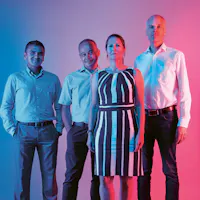

Mithun Ratnakumar, engineer; Norbert Lauber, Team Head PDD2; Sonja Lederhilger, engineer; Dominik Ziegler, Global Head of Packaging and Medical Device Development.
Published on 01/06/2020
Bulky, unwieldy and often weighing several hundred pounds, this is what medical devices such as MRI scanners and X-ray generators are known for. But given the fast development of digital technologies, a new class of software-based medical devices that, among others, can run on stylish and lightweight iPhones or iPads, are set to simplify disease management and help speed up clinical trials.
At the forefront of this new development is Dominik Ziegler’s Packaging and Medical Device Development group at Novartis. He and his colleagues, who are also working closely with teams from marketing and other units, are in the process of developing several mobile apps in areas such as lung and eye diseases.
One app that is already well advanced is centering on presbyopia, an age-related eye condition which makes it difficult to focus on close objects. The app is supporting an ongoing clinical trial of an experimental compound, helping patients assess their visual acuity and providing them with support to understand when they should see a doctor to start a new treatment cycle.
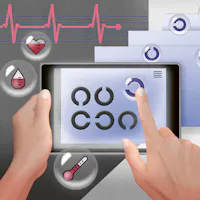
The app works like this: Instead of going to the clinic and undergoing a conventional eye test with so-called Landolt rings – a series of open circles that look like Cs, vary in size and point in different directions – patients suffering from presbyopia can open the app and perform the test themselves at home, sending the results to the doctor.
The app, however, is not just a digital translation of its analog forbear. Unlike in the clinical setting or at the doctor’s cabinet, the app does not reproduce the classic eye chart test approach of reading down the chart to the line with the smallest symbols. Rather, the software uses an adaptive approach to optimize the number of images shown to the patient, allowing a much more efficient diagnosis.
A new type of device
The app, called UMA, is in fact a novel type of medical device that has been spurred by the recent, very fast developments in digital technology. “Software as a medical device is an emerging field,” says Dominik Ziegler, who has been working in this domain for almost a decade and has been leading the group since 2017. “I have seen first-hand the transition of dedicated computers and software solutions to software as a medical device where the medical grade software can run on the patient’s smartphone or tablet.”
The field is in fact so new that regulation is still evolving. But several key points are already clear, including the need for software producers to provide a very precise description and validation of what the app actually does in medical terms.
Lifestyle apps that recommend culinary tips for losing weight, for example, are not considered as medical devices because they do not provide any clinical or medical recommendations.
However, apps designed to help obese patients reduce their body mass index and that track progress over time are classified as software as a medical device because they have a medical purpose, provide medical grade recommendations and can be installed on any compatible device – three key elements that regulators have defined as constituting software as a medical device.
Broadening the skill set
Ziegler’s group, although focusing on digital, spends most of its time on system engineering rather than coding because they need foremost to marry the world of medicine with the digital universe. “We focus on the role as integrator,” Ziegler says. “So while we don’t code the software in-house, we meet the needs of patients, doctors, marketing and clinical trial teams, to deliver software that complies with the regulations.
As part of the workflow, Ziegler and his team first engage with potential users and start with a high-level description of the product. After this initial step, the team works on the software’s function, the so-called user stories that help patients navigate their way through the app.
This new workflow has prompted the group to broaden its skill set as well as develop a more collaborative work culture.
“Our existing team, with experience in packaging and device development, was faced with completely new challenges, so we complemented our skill set with senior medical device experts with in-depth knowledge of software,” says Team Head Norbert Lauber.
One of them is Mithun Ratnakumar, who is developing engineering processes that can unite healthcare with software. In one instance, he helped design an app to differentiate between asthma and chronic obstructive pulmonary disease, which can be difficult at times, by using a defined set of health questions.
“Receiving input from our colleagues from the pulmonary franchise, our role was to translate their differentiation model into a robust software. In many ways, the process is similar to the standard drug formulation process, when a team receives a drug substance molecule from research and translates it into a drug product that can be produced and provided to patients,” Mithun Ratnakumar explains.

Focus on the user
So far, the development approach has proven successful, also because the team is focusing sharply on user needs. “User experience is a key factor to contribute to a successful product,” says Sonja Lederhilger, who is responsible for human factor aspects of any software.
Prior to any development activities, the team conducts feasibility studies with users to understand market needs and double-check assumptions before spending a lot of time and money on software development. Such user research, performed early and often, puts the user at the center and strengthens product capabilities.
“User research provides insights into the users’ habits, needs, environments and experience,” Lederhilger explains. “As an example, when it comes to technology like smartphones or tablets, we have to carefully assess the abilities of older generations to use those devices as well. We knew from previous insights that even ‘simple’ steps like downloading an app presented difficulties for older patients who require more guidance.”
Vision for the future
Since the presbyopia trial start, the app has been working well and is being used to demonstrate the feasibility of near vision testing by patients at home and in the clinic and to establish a correlation with results obtained using traditional means of visual measurement.
As the team continues to develop the app, a future version will be designed to provide the clinical teams with the ability to monitor the near visual acuity of patients throughout a trial. “Ultimately, if all goes well, a commercial version will allow patients to monitor their own symptoms and to decide when to consult their ophthalmologist for further treatment,” says Lauber.
Although the team’s work is only in its early phase, Ziegler and his colleagues are sure that such apps are about to change how patients are diagnosed and monitored in future.
The apps, they are convinced, will not only help simplify and speed up clinical trials, which are often time-consuming and a burden on patients who often need to travel long distances to get a diagnosis and treatment. They will also be instrumental in broadening data collection to include information not currently available. This, they believe, could improve diagnosis, treatment and prognosis for both common and less common diseases. Better outcomes may result, for example, if individuals are alerted to return to the clinic when changes are detected. In addition, patients can increase the frequency of measurements and measure additional aspects such as mobility.
“Software as a medical device has the potential to really change how we diagnose and monitor disease and also how we organize and structure clinical trials in future and bring clinical trials closer to the patient,” Ziegler declares. “Although we are only just at the beginning, the potential for this field is huge. We believe that together with our partners, we can help redefine clinical practice.”

Thanks for reading Live.Magazine
Stay connected by subscribing to our newsletter
SubscribeBy submitting your email, you consent to Novartis AG collecting and processing your email data for Novartis internal use, in accordance with our privacy policy, and by protected technical means.