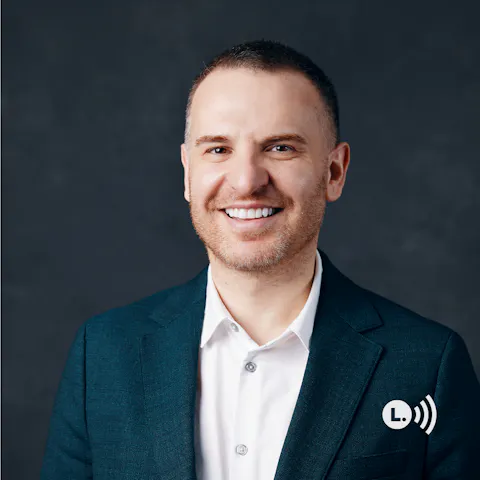
When Korab Zuka talks about impact, equity, or the responsibility of large institutions to serve the most vulnerable, he does not do it from an abstract moral position. For him, these issues are deeply personal. “I was born and raised in Kosovo,” he recounts, “and ended up fleeing during the war in the late 90s.” What followed were years marked by displacement, activism, and reinvention, experiences that ultimately shaped a career dedicated to expanding access to healthcare and creating safe spaces for people who have historically lived without them. Zuka’s story is not one of a single uprooting, but two. After escaping the war as a refugee in Canada, he returned to Kosovo to help build a nascent civil society. He worked on human rights, engaged with UN and OSCE structures, and became active in Kosovo’s early LGBTQ movement. That work made him a target. “I was thrown out again,” he says. “I ended up getting asylum in the U.S.” His voice is calm when he says it, but the reality of being exiled twice: once for being in the way of conflict, the second time for who he is, still frames the way he interprets the world. What these experiences gave him, he says, is a clear point of view. “Once you’ve gone through that, it puts things into perspective in terms of what really matters, even in day-to-day decisions.” It also instilled in him a sense of responsibility toward community, safety, and access. “I’ve always believed everyone deserves the right to a healthy life. My lived experience just reinforced that belief even more.” Arriving in the United States, Zuka faced a question familiar to many forced migrants: how to rebuild a life from scratch. “Anytime you transition countries, especially not voluntarily, you go through a process of ‘What do I want to be again?’” His earlier activism, focused on survival-level LGBTQ rights in Kosovo, did not translate cleanly to a U.S. movement focused on marriage equality and other advanced issues. “I felt like I had skipped three decades,” he recalls with a smile. “They were fighting about marriage. I had been fighting to stay alive.” Instead, he sought a space where his desire to support marginalized communities could meet a practical lever for change. Healthcare became that space. First, he volunteered at a clinic serving LGBTQ and low-income patients; then he joined a nonprofit that helped patients afford out-of-pocket medication costs. “By the time I left, we were helping 100,000 patients a year,” he says. For him, it was clear: healthcare is where he could make the most meaningful, measurable difference. His path into the pharmaceutical industry surprised some of his activist peers, but for Zuka the logic was straightforward. “Working at corporations is a perfect place to be,” he says. “You have resources, you have a platform, and you can make just as big of an impact.” Senior roles at Gilead Sciences and Bristol Myers Squibb followed, where he oversaw major public health initiatives, especially in HIV. Today, as Global Head of Social Impact and Chief Sustainability Officer at Novartis, Zuka oversees global health equity efforts, sustainability strategy, foundations, and the development of the company’s new social impact framework. His approach remains rooted in humility and lived experience. “The work is very real for us,” he says. “This isn’t limelight work. It’s our contract with society.” Our conversation spans his extraordinary personal journey, what he learned across nonprofit and industry settings, and how he sees large organizations shaping health equity in a rapidly changing world. The following Q&A has been edited for clarity and flow while preserving the conversational tone and original intent of the dialogue. Mr. Zuka, let us start at the beginning. Before we talk about Novartis or your current work, how did your early life shape who you are today? Well, I joined Novartis about a year ago, but if we go way back, I was born and raised in Kosovo. I fled during the war in the late 90s, became a refugee in Canada, then went back to Kosovo to work in the LGBTQ movement. Because of that work, I was eventually forced out again and received asylum in the U.S. Those experiences really shaped how I look at life, decision-making, and the responsibility we have to our communities. When you’ve gone through something like that, it helps put everything into perspective. You develop a grounded sense of what truly matters. Being displaced twice must leave a deep imprint. How did those experiences influence your values and later your professional path? It reinforced a belief I already had: that everyone deserves the right to live a healthy life and feel safe. When you experience persecution firsthand, you understand the importance of community, of belonging, of having people and institutions that protect you. It also makes you weigh decisions differently. You look at things from a much broader perspective because you know life can change overnight. Those experiences stayed with me and influence how I lead and how I think about social impact today. When you arrived in the U.S., how did you decide what direction to take professionally? Anytime you transition countries, especially not voluntarily, you have to ask: “What do I want to be again?” My work in Kosovo had been tied to human rights, but the LGBTQ movement in the U.S. was in a completely different place. I felt like I had jumped decades into the future. They were fighting for marriage equality. I had been fighting just to stay alive. The connection wasn’t the same. But healthcare, that’s where I found purpose. I volunteered at an LGBTQ clinic serving low-income patients. That opened my eyes to the gaps in access even in one of the wealthiest countries in the world. Eventually, I joined a nonprofit helping patients afford out-of-pocket medication costs. By the time I left, we were helping 100,000 patients a year. That’s where I felt I could make the greatest impact. Many activists are skeptical of the pharmaceutical industry. How did you decide to make that transition? A lot of my friends asked me that when I joined Gilead. But I always say: working in corporations is actually a perfect place to be if you want to have impact. You have resources, a platform, and an ability to reach patients at scale. Once I joined, I realized the gap between nonprofit and industry is much smaller than I assumed. In fact, you can sometimes have more impact because you're able to influence bigger systems and support larger communities. What was one of your early industry projects that showed you the potential for large-scale impact? At Gilead, we launched a ten-year, USD100 million initiative focused on ending HIV in the U.S. We looked at the data and realized the highest numbers of new infections and AIDS-related deaths were in the Southern U.S. We met with local organizations, physicians, advocates and other stakeholders. The initiative focused on mental health, early diagnosis, improving referral networks, and supporting local advocacy because HIV was still criminalized in some states. It was a massive effort rooted in community realities. That’s when I understood how industry can drive meaningful change. Fast forward to Novartis. You joined to lead social impact and sustainability at a pivotal moment. What were your first steps? My first priority was listening. You can’t walk into a large organization and start changing things without understanding the legacy, the culture, the context. So, I spent the first few months meeting as many people as possible. Then we began the strategic work by looking at our legacy, understanding external headwinds, and defining a north star. For us, that north star is very clear: we are a company that saves lives. We don’t need a new mission; we need to use social impact and sustainability as levers to accelerate that mission. One of the centerpieces of the new strategy is the Inclusive Health Accelerators. What are they? They’re systematic efforts to identify populations that aren’t benefiting from our scientific breakthroughs and our efforts to truly understand why these discrepancies exist. Take prostate cancer in the U.S. as an example. Black men are twice as likely to be diagnosed and have double the mortality rate. We looked at diagnostic gaps, logistical challenges and limited referral networks, among others. The accelerators allow us to design targeted interventions with precision. We’ll launch the first one in prostate cancer in 2026, then expand to cardiovascular disease and breast cancer, and eventually into other countries. You’ve also spoken about how health disparities require localized solutions, especially in the U.S. Absolutely. The U.S. healthcare system is so decentralized. Disparities manifest locally. If someone can’t get to their appointment because they don’t have transportation, no federal policy will fix that. That’s why we work closely with churches in Baltimore or academic centers like Rush in Chicago. Local partners understand their communities best. Outside the U.S., Novartis has a long history in global health. How does your strategy connect to that legacy? Our malaria work goes back 80 years. We have deep roots in global health. Recently, I was in Ghana for the launch of a new therapy and spoke with parents, physicians and local advocates. It was incredible to see how our science translates to real impact on the ground. The accelerator model can work globally because the principles are the same: understand the data, understand the disparities, partner locally, and design targeted interventions. Volunteering is also part of your remit. What does that look like at Novartis? We focus heavily on skills-based volunteering. Organizations tell us their most pressing needs, and we match those needs with employee expertise. Of course, employees can also engage in broader volunteering, but the skills-based component is where we see the biggest impact. You started your role at a time when the public conversation around corporate purpose became more skeptical. How do you navigate that? I see it as an opportunity. Many companies made loud commitments when it was in vogue. But for Novartis, this work goes back decades. It’s part of our DNA. As a consequence, moving from the limelight into the shadows doesn’t change anything. The work continues. Our contract with society is simple: ensure patients benefit from our scientific breakthroughs. Trends may change, but that responsibility does not. Environmental sustainability is another pillar of your work. What is Novartis aiming for? We’re one of only three pharma companies with a 2040 net-zero target. We focus on reducing emissions and building resilience into our supply chain as climate events become more frequent. It’s a major commitment across the organization, and the team is extremely dedicated. You’ve been at Novartis for a year. Looking back—and forward—what are your reflections? I’m proud of the strategy we built. It took time because we wanted it to be meaningful and grounded in reality. Now I’m looking forward to implementation, turning strategy into programs, tools, and interventions that deliver real impact. Strategies, of course, shouldn’t live on a page. They’re meant to guide decisions and keep patients at the center. That’s what I’m excited about in 2026 and beyond.

Thanks for reading Live.Magazine
Stay connected by subscribing to our newsletter
SubscribeBy submitting your email, you consent to Novartis AG collecting and processing your email data for Novartis internal use, in accordance with our privacy policy, and by protected technical means.