It was late afternoon. The sky over Berlin had darkened with a chilly wind driving temperatures below freezing point. Ulf Landmesser, professor at the Charité University Medicine Berlin and Director of the Department of Cardiology, Angiology and Intensive Care Medicine at the Deutsche Herzzentrum der Charité, looked back on another long day. Landmesser had already performed two stent interventions, continued with work on what could potentially become a practice- changing clinical trial, met with patients, and oversaw progress at his research lab, when he was approached by an elderly woman in the hallway who was agitated over her husband’s ill health. Landmesser listened attentively and asked her to follow him into one of the adjacent rooms to talk in private. As we observed the scene from a distance, we were once again impressed by the calm demeanor of a man whose daily task list seems to exceed what is humanly possible. Shouldering the duties of a doctor, also performing interventions, researcher and teacher at one of the world’s top university hospitals, Landmesser seemed unencumbered by his heavy workload. Much, as we learned, has to do with his vision: changing cardiovascular practice for good. “When you work as a clinician-scientist, it’s not a 40-hour-a-week job,” Landmesser told us when we visited him in Berlin. “You’re always thinking about how to advance the field, whether you’re at work, on the go, or even at home. This kind of commitment only comes if you are truly fascinated by what you do.”
Portrait of Professor Ulf Landmesser and his team in the echo-chamber.
Towards precision medicine Born in Dresden in 1970 into a family of doctors, Landmesser was drawn to medicine early on in his life when his mother introduced him to the practice by taking him to the university hospital, an atmosphere in which he felt at home even as an adolescent. Cardiology, in which one of his relatives had already made a name, was also his field of choice. After finishing his studies at Hanover Medical School, he attended the Department of Cardiology at Emory University in Atlanta for a two-year research fellowship. After gaining his professorship and working as a senior physician in Zurich, Landmesser moved to Berlin in 2014, where he now leads the Department of Cardiology, Angiology and Intensive Care Medicine at the Deutsche Herzzentrum der Charité at its Benjamin Franklin campus. He acts also as a Board member of the Deutsche Herzzentrum der Charité.
Professor Ulf Landmesser.
“One of the things that fascinated me about cardiology was how dynamic it is,” Landmesser said. “You can do so much, not only with medication but also with interventions. It’s a field full of innovation, and that was very attractive to me.” But Landmesser also cites the drawbacks of today’s practice. “We often come too late; we wait until people have symptoms, and by then the disease is quite advanced. My hope is that we can shift medicine towards early detection and prevention.” The potential of precision medicine is that treatments can be much more personalized and catered to the specific needs of a patient. “Precision medicine allows us to identify those differences – whether genetic or immune-related – and develop targeted therapies that address the root of the disease, not just its symptoms,” Landmesser explained. Potential landmark trial To improve medical practice and advance precision medicine, Landmesser is pursuing different avenues. Besides the launch of a cardiovascular prevention center at Charité, Landmesser is also working on several clinical trials. Among them are two trials with Novartis, in which Landmesser and the team are investigating a highly innovative RNA-based drug for the treatment of diseases caused by elevated levels of Lp(a) – pronounced “L P little a” – a lipoprotein that occurs naturally in the human body but can cause harm if levels are too high. One of the trials focuses on calcific aortic valve stenosis (CAVS), in which elevated levels of Lp(a) lead to the calcification of the aortic valve. This restricts blood flow from the heart to the rest of the body and can lead to heart failure or sudden cardiac death.
Andres Laguna has found a great partner in Prof. Ulf Landmesser as both are intent on driving medical innovation in the cardiovascular space.
At present, CAVS patients are treated with surgery or valve intervention only. But with the help of better diagnostic tools and a deeper understanding of the underlying genetic cause of the disease, patients can expect a more targeted treatment. Andres Laguna, who is the medical lead of Novartis for the CAVS trial, is also a strong proponent of the use of precision medicine. The former assistant professor in translational cardiology, who had previously worked at institutions such as Harvard Medical School and the Karolinska Institute, has high hopes that the trial could change medical practice. “Today, there is no approved pharmacological therapy to treat calcific aortic valve stenosis. The only option for patients is to wait until the disease reaches a final stage of severity and then undergo a valve replacement, which comes with potential negative consequences. Developing a medical treatment for these patients would be extraordinary,” Laguna said.
Landmesser is also confident about the trial’s potential: “For the first time, with our clinical trial, we hope to treat heart disease related to the aortic valve by interfering with the pathological process itself, not just replacing or managing symptoms. That’s the promise of precision medicine, and it’s why this work is so exciting,” Landmesser said. New technology For Novartis, the trial is a continuation of the company’s long tradition in the cardiovascular space, which started in the 1940s with the development of plant-based diuretics by predecessor company J.R. Geigy. In the 1960s, Ciba and Sandoz developed calcium antagonists and betablockers and were among the first to work on angiotensin-converting enzyme inhibitors, which manipulate the hormonal system of the body. Later, Novartis also worked on so-called angiotensin II receptor blockers, which help lower blood pressure. The company also achieved a breakthrough for heart failure treatment when it combined an inhibitor and a receptor blocker mechanism. The latest advance is in the space of RNA-based medicines, which have the advantage that treatments can be administered less frequently, reducing the burden on patients to follow a strict adherence pattern with daily pill intake. Novartis launched its first RNA-based treatment in the cardiovascular space a few years ago. The new RNA-based treatment, which Landmesser and Laguna are testing now, should establish whether it can slow the progression of CAVS or even reverse it. Managing Lp(a) A positive study outcome would be a major win for patients and the healthcare system given that elevated Lp(a) is both the most common monogenic cardiovascular disease risk driver and one of the strongest genetic risk factors in this space.
Elevated Lp(a) levels are genetically determined. A blood test can reveal whether a person suffers from elevated Lp(a) and is at risk to develop a cardiovascular disease. It is estimated that about one in five people worldwide suffer from elevated Lp(a), affecting around 1.5 billion people. “Higher levels of Lp(a) predispose patients to multiple cardiovascular diseases, such as myocardial infarction, stroke, or calcific aortic valve stenosis. Addressing it is important for the future of cardiovascular care,” Laguna emphasized. Cross-industry collaboration Against this background, innovation is urgently needed. This not only means that researchers must work on new molecules, but that medical practice needs to be changed too, requiring new procedures and protocols.
Diligent diagnosis is a key step towards personalized medicine.
Cross-industry collaboration is high on the agenda to achieve progress. “In cardiovascular disease, we need to develop precision treatments, just like oncology has,” Landmesser explained. “It’s more advanced because you can study tumors directly. In cardiology, we’re just starting to uncover these mechanisms.” “One of the fascinating things we’re working on now is using genetic studies to identify causal targets and then directly treating those. It’s an exciting shift from simply managing disease to addressing the underlying pathology,” Landmesser said. The multicenter CAVS trial, which started in 2024 and is expected to last until 2029, is set to enroll around 500 patients with mild or moderate calcific aortic valve stenosis in Germany, the United States, and other countries. The goal is to collect as much proof as possible. “The first step is evidence – clinical trials that demonstrate a clinically meaningful benefit. The second step is to look at the whole picture – not just individual studies, but the entire evidence base. We rely on very solid evidence because we’ve seen how intuitive assumptions can be proven wrong by rigorous research. Evidence-based medicine is essential for advancing clinical practice and ensuring patient trust,” Landmesser added. Vital research For Landmesser, the clinical trial is part of a much broader curriculum, which not only includes cardiovascular interventions, patient visits, and teaching assignments as part of his professorship. He is also fully invested in driving basic and applied research. On Charite’s Benjamin Franklin campus, Landmesser also runs a research lab, which is dedicated to driving the genetic and translational analysis of coronary diseases. A team of around a dozen scientists is working on deepening the understanding of the key triggers for a variety of coronary diseases. In a recent paper, researcher Denitsa Meteva investigated heart attacks caused by plaque erosion in which neutrophils, a type of immune cell, become highly activated, damaging blood vessel linings and worsening the condition by promoting thrombus formation in coronary arteries. In the study, she showed that blocking a key activation pathway could help reduce this damage and might be useful in preventing future heart attacks. Such studies are extremely important, emphasized Landmesser, who also acts as the deputy editor of the European Heart Journal, which has become one of the leading cardiovascular journals in Europe.
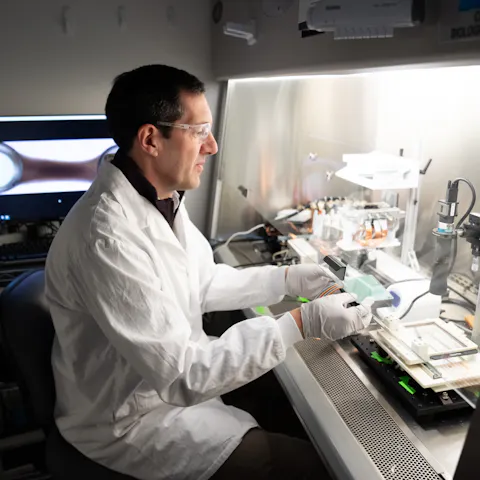
Basic research is part and parcel of the clinical program at Charité.
“I think what’s also interesting is how we’ve been able to combine work in the lab with clinical practice. About 25 years ago, it was much easier to do both, but now the two fields have become so specialized. Yet, understanding both sides is crucial for real progress,” Landmesser said. Patient-driven motivation While the trial has only just started, Landmesser and Laguna are both confident about its far-reaching potential for cardiovascular medicine. “Charité has such a long history of paradigm shifts in medicine,” Landmesser said. “It’s motivating to think about how we can contribute to shaping the medicine of the future. This connection to the past and focus on innovation is what brought me here.”
For Laguna, the trial is a career dream come true and one of the reasons he switched from academia to industry. “When I was a teenager, I dreamed of discovering something that could be translated into a therapy for people without treatment options,” he said, adding that “while academia was a stepping stone, working in industry has allowed me to bring that dream closer to reality by leading a clinical trial that may impact millions of lives.” Meanwhile, the heavy workload for both Laguna and Landmesser is not hindering them from thinking big. To the contrary, both feel deeply responsible for the patients they aim to treat. “What I find rewarding is not just the science but the interaction with patients,” Landmesser concluded. “Every patient is different, with their own story, and understanding their perspective adds a lot of meaning to the work. It’s this connection that keeps me motivated.” The scene with the agitated woman comes to my mind. Once she and Landmesser came out of the room, the woman still looked sad, but she seemed much calmer. Landmesser had been able to comfort her and soothe her fears, and she must have felt that he and his team were working at their peak and that her husband was benefiting from the best treatment possible. Encounters like this, it seems, drive Landmesser forward and, with him, cardiovascular health around the world.
You may also be interested in the following:

Thanks for reading Live.Magazine
Stay connected by subscribing to our newsletter
SubscribeBy submitting your email, you consent to Novartis AG collecting and processing your email data for Novartis internal use, in accordance with our privacy policy, and by protected technical means.