
Published on 01/07/2021
A year into the remediation work, in June 2013, the first odor complaints were received from the neighboring communities in Basel’s Klybeck area, just across the Swiss border and downwind from the remediation site. The project team inspected the site, but could not locate the source of the odor. Work continued as planned.
Odor thresholds differ from one HCH isomer to another. The American Agency for Toxic Substances and Disease Registry (ATSDR) describes the odor of γ-HCH as a slightly musty odor, while the odor of α-HCH is described as phosgene-like. No official reports describe the smell of the β-isomer.
At the end of August 2013, odor complaints were filed by Novartis employees. The Novartis Health, Safety and Environment (HSE) unit, which had been involved since the beginning of the project, reviewed the results from the regular air measurements conducted by the service provider (as agreed during the contract negotiation). From the start of the remediation project in 2012, this emission monitoring had indicated no instances of breaching the site emission limits.
Musty smell
On Saturday, August 31, the HSE team called the fire department to the site following a report about an unpleasant, “musty” smell. An excavator whose caterpillar tracks were full of soil was identified as the source of the odor. The fire department took various air samples and also carried out surface wipe tests. The fire department detected TCB (20 µg/m3) as well as α-, β- and γ-isomers of HCH in the nanogram range.
The air concentrations were below the established values set by the French prefectural order. Since dust is diluted as it spreads, the HSE team concluded with a high degree of probability that no quantities of γ-HCH hazardous to health were present in the air outside the remediation area. The concentration of TCB measured in the air was well below the MAC defined for the site (the limit was 20 mg/m3), but above the level of concern for the population (the residential area threshold for the general population is 4 μg/m3 according to the Canadian regulation on contaminated sites).
Extensive investigations
Following the fire department’s detection of TCB and HCH, the Novartis HSE team, under the guidance of the project core team, commissioned an extensive investigation of the area. Samples were collected on the remediation site on September 2. Other compounds were found to be present in addition to the HCH isomers.
Starting on September 7, the HSE team conducted daily ambient air monitoring, and four additional chlorinated compounds – di-, tri-, tetra- and pentachlorobenzene – were also analyzed in addition to the four main HCH isomers.
The air monitoring was done in addition to the already established monitoring plan. The sampling and analysis were conducted according to the recognized occupational health method of the American National Institute for Occupational Safety and Health (NIOSH) for lindane.
HCH isomers and chlorinated benzenes were detected in the air in the immediate vicinity of the remediation site. As with the measurements performed by the fire department, the highest concentrations of TCB were also determined in these measurements. The highest concentrations of TCB were measured at the remediation site (around 37 µg/m3) and on the Novartis Campus (around 59 µg/m3).
To rapidly understand the situation and to determine whether any dust had spread to neighboring Switzerland, 20 swab samples were collected around Basel on September 10, including surfaces, walls, equipment and machinery, and analyzed for the four main HCH isomers. α-HCH was detected at 17 of 20 positions and β-HCH at 19 of 20 positions. The measured concentrations varied between 0.28 and 1,717 µg/m2 and between 0.33 and 1,345 µg/m2, respectively. The highest concentration was found on the remediation site’s entry gate. γ-HCH was only detected at a few points in the immediate vicinity of the remediation site.
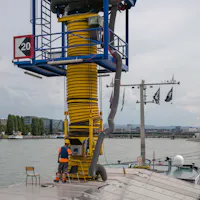
Two days later, additional samples were taken from the barge during the loading of soil containing HCH. High concentrations of TCB of up to 606 µg/m3 were detected. However, the measured levels of HCH were below the site limit.
Work suspended
On September 20, additional complaints of an unpleasant smell were received by the HSE team and additional air sampling was performed in the Klybeck area of Basel. Based on these measurements, Novartis concluded that HCH-containing dust was being distributed by the wind from the remediation site to neighboring Switzerland and that it affected the area outside of the remediation site. As these emissions could not be reduced in the short term, Novartis suspended the remediation work on September 24, 2013.
Air quality measurements conducted by the Canton of Basel-City and Novartis showed that odor emissions and the dispersal of lindane (HCH)-contaminated dust caused by the remediation could not be reduced as anticipated. Based on these measurements, the site, however, never posed a risk to people or the environment.

You may also be interested in the following:

Thanks for reading Live.Magazine
Stay connected by subscribing to our newsletter
SubscribeBy submitting your email, you consent to Novartis AG collecting and processing your email data for Novartis internal use, in accordance with our privacy policy, and by protected technical means.