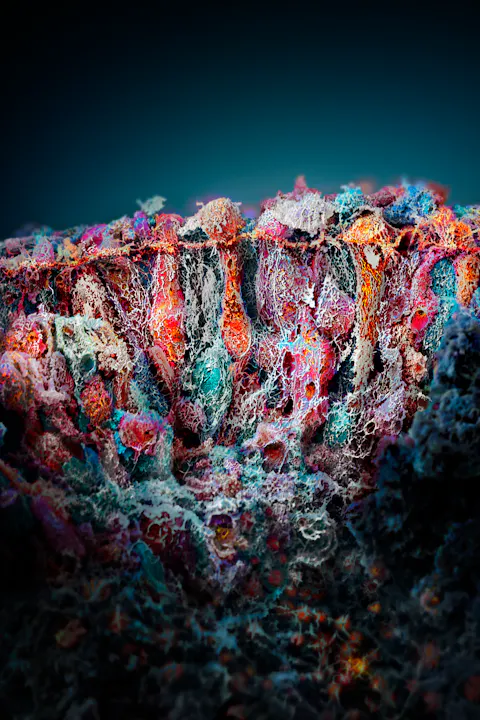
Stefan Spirig was behind the steering wheel, while a colleague of his was holding a vessel in his lap that held a rare and precious content: a couple of thousand retinal organoids that had been painstakingly prepared for months at the Institute of Molecular and Clinical Ophthalmology Basel. Spirig had to transfer the material from the IOB headquarters in Klybeck to the Novartis Campus in Basel’s St. Johann quarter to continue with his project, which entailed a large compound screen. He and one of his colleagues had to make the short trip several times since they had to transport a total of around 20,000 organoids. Once on the Campus, Spirig would start to test the organoids against around 3,000 molecules from the Novartis compound library with the intention of establishing whether any of the therapeutic molecules had an impact on degenerated cone photoreceptors, which are often the cause of severe diseases such as macular degeneration or retinitis pigmentosa. It was one of the first such screens at Novartis with 3D tissue samples, which have emerged as valuable alternatives to difficult-to-obtain human cells or animal samples, which often give researchers the wrong clues when they aim to work on human therapies later – a fact that has held up the field of ophthalmology for a long time. The screen was a culmination of events that had started a few years earlier when Spirig was looking to pursue a gene therapy project for his Ph.D. after completing his studies in Zurich. He received an opportunity to work at the IOB, where Director Botond Roska assigned two projects to him. “I was able to work on a gene therapy project right away, but Botond also assigned me to do a compound screen,” Spirig said, adding that he was less interested in the screening project because it was initially not focused on gene technology. “Both projects were risky and, a few months down the road, the gene technology project hit a dead end,” Spirig said. “But as is often the case in science, the side project suddenly showed huge potential and I got extremely interested in working with organoids. As an extra, the project led to a gene therapy venture in the end.” Preparing the screen Although Spirig had little acquaintance with organoids before he joined the IOB, he got quickly up to speed after collaborating with the lab of Magdalena Renner, who was not only an expert in the field but was the first scientist to generate retinal organoids in large numbers and whose method was instrumental to produce the 20,000 organoids needed for the screen.
While the retina development process is lengthy and complex, Renner’s lab can produce thousands of them today. When she and her team started out a few years back, they usually could generate only a few dozen high-quality organoids. When asked by Botond Roska how many they could prepare for a compound screen, Renner and Spirig calculated that 10,000 could work. Botond suggested doubling the amount. “This was so typical of him,” Spirig and Renner said laughingly. “It’s the ambition with which he wants to move things ahead.” After brainstorming with Roska, Spirig said that they decided to pursue a compound screen to test potential therapies for conditions that cause blindness due to cone photoreceptor degeneration and for which there are no therapies yet. “Our goal was to develop a therapeutic intervention to slow or halt this kind of degeneration,” Spirig said. “We envisioned a large-scale experiment using organoids to simulate cone photoreceptor degeneration – a condition mimicking age-related macular degeneration and retinitis pigmentosa, common causes of blindness.” By depriving them of glucose, which is the primary energy source for these organoids, Spirig was able to induce a state of starvation and observed rapid cell death, particularly in cone photoreceptors. “This model,” he explained, “enabled us to test drugs that could potentially extend the survival of these crucial cells.” As part of the experiment, they would starve all the cone photoreceptors in the organoids, and later add the compounds to find out if some of the therapeutic molecules could prevent those cells from dying or prolong their life by as much as possible. Collaboration with Novartis At Virchow 16, where Novartis stores its massive compound library with more than 1 million potential therapeutic molecules and has automated high-throughput screening technology in place, Spirig’s team started to prepare the test and worked together with colleagues from Novartis.
Using the equipment and molecule library at Virchow 16 was key. Although Spirig was able to prepare the experiment setup at the IOB, he needed the technological framework at Novartis to proceed with the screen and use the compounds. Novartis researcher Daniel Baeschlin, who oversees the company’s compound library and automated high-throughput screening, said that not only was the collaboration good, but he and his team were impressed by the setup of the screen and the energy of Spirig and his colleague. “You could really feel how extremely motivated they were,” Baeschlin said. “From our point of view, it was a very ambitious program and by far one of the most complex organoid screens that we had to perform here because it involved such a large number of artificial retinas.” Unlike in automated high-throughput screens in which compounds are tested against 2D cells, the team had to do a lot of manual work with their 3D organoids for which no fully automated system was in place yet. “We started from scratch by creating a screening setup with well plates, each containing a single organoid exposed to different drugs. So, 20,000 organoids had to be put into these wells individually,” Spirig said. Once the organoids were prepared in the wells, the team added one of the 3,000 compounds in each well. “Novartis sometimes screens a million compounds in one go,” Spirig said. “But for us that was impossible.” First, the team did not have as many samples. Second, because organoids are so variable, they had to test the same compound multiple times on multiple organoids. Adding the compounds also included partially automated steps. “Usually, I had to press some buttons,” Spirig said. Several hits After starving and colorizing the cone photoreceptor organoids with a green fluorescent protein, the team took high-resolution images of the organoids with the help of a spinning disk confocal microscope that can take pictures fast. A week later, they would add the compound and after that take another high-resolution picture to see whether the cone photoreceptors were degenerated or still intact. The whole process, which took around two years to develop, screen and evaluate all 20,000 organoids, led to several hits. “I am very happy that we were able to identify several compounds,” Spirig said. Two of the molecules were kinase inhibitors, which protected the cones from degeneration in both the short and the long term. Another group of molecules initially protected the cells, but later damaged them. Other inhibitors also showed interesting activity.
True milestones can only be achieved together.
Through the project, Spirig’s research has helped to create a large database, which the IOB will make accessible to researchers worldwide through the website https://conetargetedcompoundscreen.iob.ch/. It could one day form the basis for the development of new treatments that can slow down or even prevent the progression of diseases such as macular degeneration. Gene therapy project For Spirig, the journey meanwhile goes on. It is even coming full circle as the project is now evolving into a gene therapy venture, which he had been looking for since he joined the IOB more than five years ago. As Spirig was working to identify the exact protein targets, he also took a closer look at the genes that are involved in the creation of these proteins, allowing him to understand the underlying genetic process that can cause cone photoreceptor degeneration. “Now, as we know the genetic targets, we can start to look at gene therapies that can down-regulate these genes,” Spirig said. “Thus, we can actually work on a potential gene therapy that prevents the degeneration of these cells.” While this leg of the research journey may also take a few years, the IOB has what it takes. Less than a decade after the institute was created, researchers here have already gained substantial new insights and have paved the way for an optogenetic gene therapy designed to treat a hereditary form of blindness and are working on a similar project to treat Stargardt disease, which affects the macula. “It is really exciting, and while I may have been less interested in organoids at the beginning, I have to admit that I grew really fond of them, much like when I was on the lookout for a gene therapy project,” Spirig said.
You may also be interested in the following:
Thanks for reading Live.Magazine
Stay connected by subscribing to our newsletter
SubscribeBy submitting your email, you consent to Novartis AG collecting and processing your email data for Novartis internal use, in accordance with our privacy policy, and by protected technical means.