
This article was originally published in August 2015.
Published on 05/06/2020
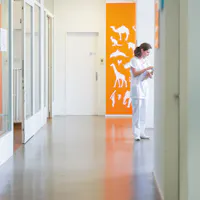
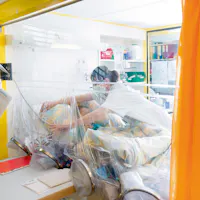
Janine Reichenbach takes a moment’s break, stands in the corner of the room and turns her attention to the nurses who go about their work. It is lunchtime, and the isolation ward for stem cell transplantation at the University Children’s Hospital Zurich – affectionately known here as the “Kispi” – is unusually busy. Lunch is brought to the patients and then cleared away, while nurses rush around with the necessary medication. While this is going on, Tayfun Guengoer, Head of Pediatric Stem Cell Transplantation, does his rounds, speaking briefly with his young patients and putting worried parents at ease. Janine Reichenbach’s break doesn’t last long – after just a few moments her phone rings.
Free time and relaxing weekends are a rare treat for Janine Reichenbach. The Assistant Professor for Pediatric Immunology at the Univer-sity of Zurich and Co-Director of Immunology at the University Children’s Hospital Zurich is almost always on call. Either she is caring for children at the Kispi in her role as doctor, researching new treatment methods with her research team or holding lectures as part of her professorship. Janine Reichenbach specializes in septic granulomatosis – a disease of the immune system that is triggered by one or more genetic defects – and has been instrumental in promoting a gene therapy that treats this rare condition.

Where research and practice meet
“My work doesn’t leave much room for free time,” she admits. “And yet, the possibility of combining work in the hospital with research can be very rewarding. As a doctor, you are very often a long way from the research side of things, while researchers rarely experience everyday life at the hospital and usually have no contact with patients. I can do both – target my research specifically according to the needs of the patients and then get their feedback immediately. The two areas are mutually beneficial.”
Janine Reichenbach loves the cadence of her work. As she explains, she was fascinated by science from an early age. Even back at school, she showed an interest in immune diseases. During her training to become a doctor, she became increasingly interested in pediatrics – though she never lost sight of immunology. Following positions in Frankfurt am Main, Lyon and Paris, she wrote her doctoral thesis at the Center for Pediatrics and Adolescent Medicine in Frankfurt and came to Zurich in 2006 to complete her postdoctoral qualifications. Almost from the outset, she worked together with Reinhard Seger, a pioneer in gene therapy for patients with septic granulomatosis.
Shortly before Reichenbach came to Zurich, Reinhard Seger – who retired in 2012 – developed the first gene therapy for patients with septic granulomatosis together with Dieter Hoelzer from the Frankfurt University Clinic and Manuel Grez from the Institute for Biomedical Research in Frankfurt. Seger’s success further enhanced the international reputation of the University Children’s Hospital Zurich, which achieved global recognition in the late 1970s and 1980s thanks to the work of Walter Hitzig in the field of pediatric immunology.
“My decision to come to Zurich and work at the meeting point be-tween research and practice was also driven by a real desire to move something,” says Janine Reichenbach. Despite her high workload, she appears relaxed – and never loses her smile in spite of her determination and concentration on her work.

Pioneers of immunology
Janine Reichenbach has been able to move many things since her arrival in Zurich. She has played a pivotal role in advancing gene therapy and improving the understanding of the basic mechanisms of septic granulomatosis.
But this road was long and built on the years of work by her predecessors. At the turn of the millennium, gene therapy was still in its infancy and only a few researchers and doctors dared to venture into the field. Although the Human Genome Project opened up new opportunities for doctors, therapies based on this knowledge were rare or ineffective. Genetic research was also caught in the crossfire of international criticism in 1999, when a young patient died in the USA during a clinical study.
Despite this, the team led by Reinhard Seger at the University Children’s Hospital Zurich still pressed forward with gene therapy for strictly selected patients who had no other chance of survival, even though they were fully aware that new therapies can involve certain unknown risks. Seger’s team was, however, used to major challenges. Back in 1987, Walter Hitzig and Reinhard Seger had successfully carried out the first bone marrow transplant on a child with a serious immune deficiency. This then paved the way toward establishing a therapeutic regime through which hematopoietic stem cells from a donor could be transplanted into a patient, thus saving the lives of many children and making diseases such as septic granulomatosis treatable in many cases.
However, due to the severity of the illness not all patients with septic granulomatosis are suitable for stem cell transplantation. Also, between 2 and 5 percent of those affected still die each year despite optimal drug intake. With this in mind, Reinhard Seger and his colleagues in Frankfurt developed a gene therapy where the hematopoietic stem cells of the patient are genetically altered with the help of modified retroviruses (inactive viruses that carry the healthy gene).
Initially, the therapy – which was first carried out in 2005 – was a success. However, it soon became clear that while the treatment helped strengthen the patients’ immune system, the retroviruses which were used as gene shuttles triggered bone marrow disorders in some patients, who had to be treated with stem cell transplantation. In other patients, the effects of the gene therapy subsided after some time after the transplanted genes became inactive.
“Looking back, we can now see that the first generation of gene therapy wasn’t without its risks and side effects for the patients,” explains Janine Reichenbach. “Despite this, most of the patients – who would hardly have had any chance of survival otherwise – could be helped. We have also learned a lot since this time, which is critically important for the further development of gene therapy.”

Rare genetic defect
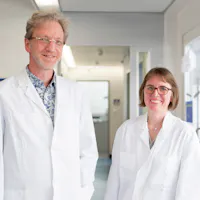
Septic granulomatosis is only diagnosed very rarely and affects 1 in 70 000 people on average. Sufferers have a genetic defect in the phagocytes (white blood cells). While these are able to detect pathogens, they are not able to kill off bacteria and fungi.
Patients are thus constantly exposed to the risk of infection and are unable to survive without permanent drug treatment. Children are primarily affected by the disease, which severely restricts their activity – playing outside in the woods is out of the question, for example.
Further progression of the disease – which can cause severe infections of the lungs and other organs, inflammatory reactions in the bowels or accumulations of pus – usually means the only hope is a stem cell transplant. However, gene therapy is the only option for around one-third of patients because neither their relatives nor other donors have the same tissue group which is necessary for a stem cell transplant.
To prepare for the gene therapy, the stem cells are first detached from the bone marrow and then fed into the bloodstream, where they can be filtered out. After preparation in the laboratory, the stem cells are treated with the help of retroviruses.
Before the hematopoietic stem cells are reintroduced via infusion, the patients undergo a course of selective chemotherapy. This kills part of the stem cells found in the bone marrow of the patient, which is needed to make room for the new, genetically altered stem cells. Once in the body of the patient, the new stem cells redevelop a complete immune system. This includes healthy phagocytes, which then help the patient to fight infections.
“For patients, treatment with gene therapy is not much different from a stem cell transplant,” explains Janine Reichenbach. “However, in recent years we have been able to significantly improve our understanding of the disease and also make major progress in developing new retroviruses, which has made a marked improvement to the safety and efficiency of this gene therapy.”

Continuous gains in knowledge
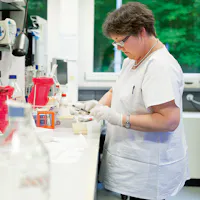
With her group of scientists, Janine Reichenbach works closely together with biochemist Ulrich Siler. In 2011, they found that the protein calprotectin plays a key role in protecting against fungal infections in patients suffering from septic granulomatosis. Based on these findings, they are now researching new methods for an innovative therapeutic approach to be used in addition to stem cell transplants and gene therapy.
Back in 2010, Janine Reichenbach received the Science Prize from the Walter and Gertrud Siegenthaler Foundation for her work in demonstrating that normal phagocytes release DNA traps when they die. Antimicrobial substances stick to these traps and kill off fungi that have entered the body. If this mechanism fails due to a genetic defect in the phagocytes, gene therapy can regenerate it and rid affected children of chronic fungal infections.
The group of around a half-dozen scientists is also working intensively on improving gene therapy to eliminate the weaknesses of the first generation of retroviruses. Significant progress has already been made here, with the group currently taking part in an EU-funded Phase I/II clinical gene therapy study together with leading children’s hospitals such as Great Ormond Street Hospital in London, the Frankfurt University Clinic, the Georg-Speyer-Haus (a leading institute in the field of tumor biology), the Hôpital Necker-Enfants Malades in Paris and the French non-profit organization Généthon, which is active in research and development in the field of biotherapy.
“We are also working on testing new technologies such as CRISPR, even though we can’t use these for gene therapy in humans just yet,” explains Janine Reichenbach. CRISPR is a new technology developed in 2012 that makes genetic modification significantly easier and more cost-effective than existing methods. Many clinics and research institutions are already using this technology ex vivo, and some researchers hope that the first therapies for humans will already be developed within the next few years.
Even though the future appears promising when looking at the new technologies, Janine Reichenbach still retains her scientific sense of reality. “It’s important that we concentrate on the patients during our work and that we progress step by step as we have done in the past,” she explains.

Teamwork and communication
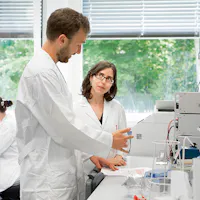
Teamwork and communication are of key importance, as the insights that Reichenbach sees in practice have to find their way into research efficiently.
“Communication is absolutely decisive,” comments Ulrich Siler. “It’s not just about sharing news on the latest developments. We also constantly ask ourselves in which direction we are going. When we share our thoughts and ideas, I don’t get the impression that we are talking at cross-purposes, which is something that can easily happen and something I have experienced elsewhere.”
As a biochemist, Ulrich Siler also appreciates the close proximity to the patients. “Access to patient material is extremely important for us scientists. But it makes a difference on an emotional level as well – the sense of closeness to people, seeing them in person and receiving a letter all provide a real motivational boost.”
The colleagues in the immunology group share this view. Two of them – Rocio Valencia and Elena Kuzmenko – monitor the stem cells and blood count of the patients. “For scientists, there is a huge difference between examining cells and blood from a patient who is undergoing treatment and simply analyzing an anonymous material sample. This gives our work an added sense of urgency.”

“The patient always comes first”
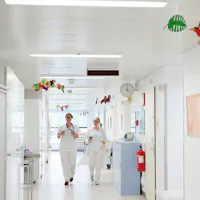
Janine Reichenbach shares this view. For her, the interests of the patient are always of paramount importance. “Of course, it isn’t easy to harmonize the requirements of working in the hospital and in the laboratory. However, it is clear that the interests of the patients always come first, whether during your rounds, on night shifts, when carrying out regular check-ups or talking to parents.”
Even during her apparently short break on the isolation ward, nothing escapes Janine Reichenbach’s eye. She notices how one of the young patients, who seems bored, lies in bed, watching TV, while his mother sits next to him and asks him whether he would finally like to eat a little since it is already past lunchtime.
Janine Reichenbach also sees how the mother doesn’t rush her son and how sad and worried her eyes look. When the boy begins to cry and the mother comforts him, Janine Reichenbach becomes all too aware of the mother’s worries and how difficult it will be for her to go home and leave her son alone in the isolation ward during the 10-day course of chemotherapy.
“On the one hand, this is part of everyday life in the hospital,” explains Janine Reichenbach. “And yet such moments when you really see the pain and suffering on people’s faces make it clear why we have to carry on with our research – and why it always pays off to keep on going, despite the extremely hard work that is often required in the hospital and laboratory. When you see a child recover from an illness it also helps you get over the fact that some children die despite all your efforts to help them.”

You may also be interested in the following:

Thanks for reading Live.Magazine
Stay connected by subscribing to our newsletter
SubscribeBy submitting your email, you consent to Novartis AG collecting and processing your email data for Novartis internal use, in accordance with our privacy policy, and by protected technical means.